
EATG, a member of the Coalition for a European HIV Response (C4EHR), endorses its Joint Statement, Europe’s Unfinished Epidemics: Sustaining Community-Led HIV Response in Times of Crisis.
5 May 2026
Over the past months, partners across the HIV field have come together under the Coalition for a European HIV Response (C4EHR) to develop the Joint Statement Europe’s Unfinished Epidemics: Sustaining Community-Led HIV Response in Times of Crisis. The statement highlights a critical moment for Europe: while the tools to end HIV as a public health threat exist, political commitment and sustained investment are weakening. Europe remains off track to meet agreed targets, and community-led responses are increasingly undermined, with rising infections, preventable deaths, and widening inequalities as a result.
The statement calls for urgent EU action, including a renewed HIV Action Plan, sustainable funding for community-led programmes, and stronger EU leadership globally.
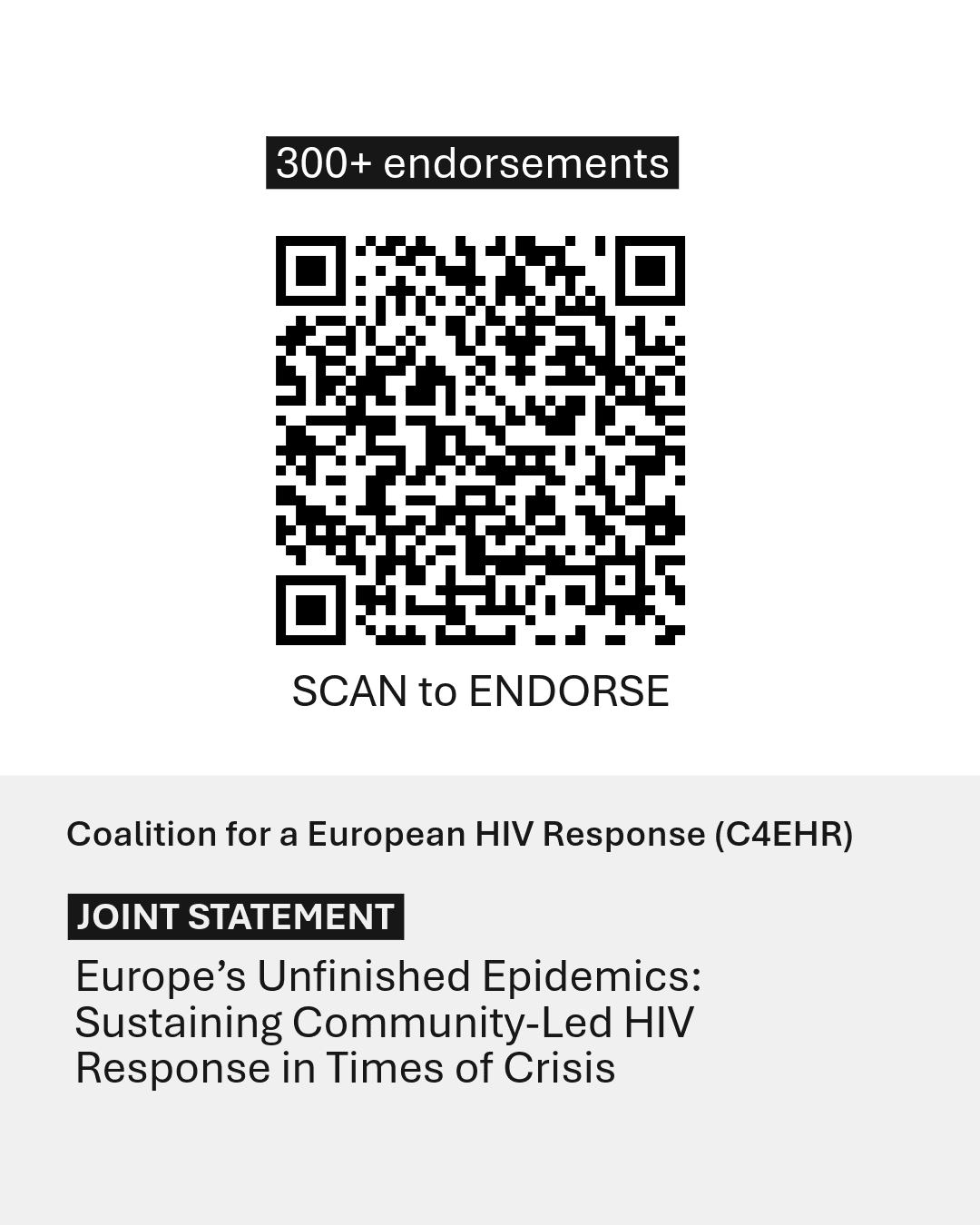
It has already been endorsed by more than 100 organisations and over 200 individuals, reflecting strong and growing support across the region. Endorsements remain open: organisations and individuals are invited to add their support here: https://cloud.aidshilfe.de/apps/forms/s/MkJK6Wnr39pMzJJAHYj9r6ZD
Read the Joint Statement below.
Joint Statement
Europe’s Unfinished Epidemics: Sustaining Community-Led HIV Response in Times of Crisis
Europe stands at a turning point. The tools to end HIV as a public health threat are available, but the political will and sustained investment required to use them are weakening.
Despite progress, Europe remains off track to meet agreed targets on reducing new HIV acquisitions, morbidity, and societal enablers. At the same time, community-led programmes – central to prevention, testing, treatment access, and human rights – are being undermined by shrinking funding and declining policy attention.
The consequences are immediate: rising new HIV acquisitions, preventable deaths, and widening inequalities across and within Member States.
This trajectory is not inevitable. It is the result of policy choices.
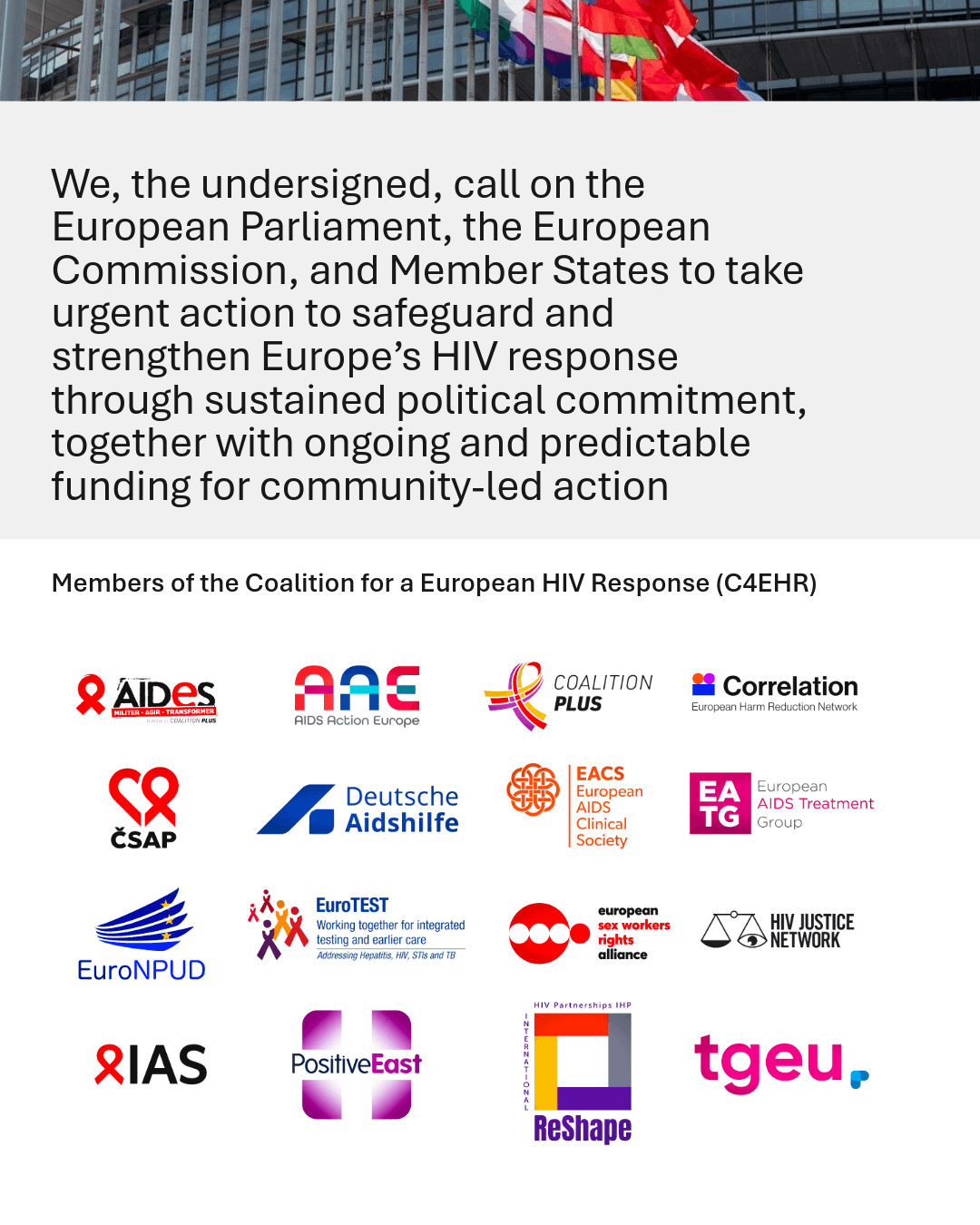
We, the undersigned, call on the European Parliament, the European Commissions, and Member States to take urgent action to safeguard and strengthen Europe’s HIV response through sustained political commitment, together with ongoing and predictable funding for community led action.
1. Renewed EU Action Plan on HIV and other communicable diseases
We call on the European Parliament to urge the European Commission to develop and implement, without delay, a renewed EU Action Plan on HIV and other communicable diseases.
This Action Plan should:
- align with the Global AIDS Strategy 2026–2031;
- set clear targets, timelines, and accountability mechanisms;
- support Member States in achieving the 30–80–60 community leadership targets; and
- ensure meaningful and systematic involvement of civil society.
It must recognise community-led, integrated services as a core component of effective health systems and support enabling legal and policy environments that address stigma, discrimination, and punitive laws.
2. Sustainable EU funding for community-led HIV response
We call on the European Commission to ensure sustainable, predictable, and accessible EU funding for community-led HIV responses within EU4Health and the next Multiannual Financial Framework (2028–2034).
EU financing should:
- include a balanced mix of operating, action, and project grants;
- ensure resources reach community-led organisations, including through flexible funding mechanisms;
- support long-term sustainability through social contracting and domestic co-financing; and
- safeguard funding for ongoing epidemics alongside investments in emergency preparedness.
Community-led systems must be recognised and resourced as integral to public health delivery.
3. Strengthened EU leadership in the global HIV response
We call on the EU to and its Member States to exercise global leadership by championing the adoption of an ambitious 2026 UNGASS Political Declaration on HIV and AIDS that fully and unequivocally reflects, and is aligned with the goals, targets, and principles of the Global AIDS Strategy 2026–2031, while ensuring coherence and alignment across internal EU policies.
This includes:
- prioritising human rights, gender equality, and community leadership;
- supporting integrated, community-led responses in partner countries; and
- strengthening investment in research and innovation, including participatory-based research.
In a context of shrinking global resources, the EU must scale up predictable financing, reinforce multilateral cooperation, and support enabling environments for civil society.
Background
The European Union is at a critical juncture in its HIV response.
Despite repeated commitments to ending the HIV epidemic as a public health threat[1], and commitments to targets in the UN 2016 and 2021 Political Declarations on HIV[2], and the Global AIDS Strategy (2021-2026)[3], Europe remains significantly off-track.
Recent ECDC data highlights the scale of the gap:
- new HIV acquisitions have increased by 5% instead of declining by 75%;
- AIDS-related deaths have risen by 37%; and
- only 70% of people living with HIV have achieved viral suppression, far below the 86% target.
Behind these numbers are people – and growing inequalities between and within Member States
Similar structural gaps affect responses to other communicable diseases, including viral hepatitis.
Community leadership – a key pillar to the successful response
Community-led organisations are essential to effective HIV responses. Yet progress in supporting and measuring community leadership remains insufficient, despite clear global commitments to the 30–80–60 targets.
According to data from ECDC[4], the EU/EEA HIV epidemic mostly affects key populations[5], their partners, and other marginalised groups such as migrant communities or women, especially where these identities intersect. These groups continue to face structural barriers, including stigma, criminalisation, and discriminatory policies, that restrict access to prevention, testing, and treatment. This includes limited access to the preventive benefits of treatment itself, known as Treatment as Prevention (TAsP), whereby people living with HIV who adhere to their treatment and maintain an undetectable viral load, do not transmit the virus. The result is later diagnosis, poorer health outcomes, and widening health inequalities. Significant disparities also persist between Member States, including in access to pre-exposure prophylaxis (PrEP).
Community-led organisations play a critical role in addressing these gaps. They deliver prevention, testing, treatment, and care services to populations underserved by traditional health systems, often with high levels of efficiency and cost-effectiveness.
Recognising this, community leadership is identified as a core priority in the Global AIDS Strategy 2026-2031. The meaningful involvement of communities at all stages of the response (from planning and implementation to monitoring and evaluation) is essential to achieving effective and equitable outcomes.
Global targets commit to:
- 30% of testing, treatment, and care services;
- 80% of combination prevention for key populations; and
- 60% of advocacy activity for enabling legal and policy environments
being delivered by community-led organisations.
Achieving these targets requires sustained political commitment, adequate financing, and enabling legal and policy frameworks.
Urgency
This situation is compounded by recent funding decisions at both EU and global levels.
The EU4Health 2025 Work Programme has removed HIV-specific funding calls and reduced support for regional health networks, while prioritising emergency preparedness. At the same time, global funding reductions – including cuts to PEPFAR, USAID, and contributions to WHO, UNAIDS and the Global Fund – are weakening HIV responses in neighbouring regions, with direct implications for the European Union.
This moment demands more than concern. It demands leadership.
Funding cuts are already undermining the systems that deliver results. Prioritising emergency preparedness while neglecting ongoing epidemics is a false economy that will cost lives and reverse hard-won progress.
But the path forward is clear.
With sustained political commitment, predictable investment, and a renewed focus on community-led responses, Europe can still change course and meet its commitments.
The question is no longer whether this is possible. It is whether the European Union will act.
About the Coalition for a European HIV Response (C4EHR)
The Coalition for a European HIV Response (C4EHR) brings together civil society, community-led and community-based organisations and networks, as well as academic and scientific associations across Europe with a shared mission: ending HIV as a public health threat in Europe and beyond. We advocate for the political commitment and sustained investment that communities need and deserve, because the tools to end HIV exist, and the only thing standing in the way is political will.
For queries, please contact:
Members
AIDES (France)
AIDS Action Europe (AAE) (Germany)
Coalition Plus – Platform Europe (France)
Correlation – European Harm Reduction Network (Netherlands)
Czech AIDS Help Society (Czechia)
Deutsche Aidshilfe (Germany)
European AIDS Clinical Society (EACS) (Belgium)
European AIDS Treatment Group (EATG) (Germany)
European Sex Workers’ Right Alliance (ESWA) (Netherlands)
EuroNPUD – European Network of People who Use Drugs (Ireland)
EuroTEST (Denmark)
HIV Justice Network (Netherlands)
International AIDS Society (IAS) (Switzerland)
Positive East (United Kingdom)
ReShape/IHP (United Kingdom)
TGEU – Trans Europe and Central Asia (Germany)
This Joint Statement is endorsed by
(last update: 4 May 2026)
ORGANISATIONS
| Revers | Russian Federation |
| Alternative Fundation | Hungary |
| Youth view | Tajikistan |
| Women and Modern World Social Charitable Center – CWMW | Azerbaijan |
| Fundacja Edukacji Społecznej/ Foundation for Social Education | Poland |
| Queer Geography, z. s. | Czechia |
| Non-profit Partnership “Alliance for Public Health” | Republic of Moldova |
| Center for Information and Counseling on Reproductive Health – Tanadgoma | Georgia |
| ARAS -Roamanian Association against SIDA | Romania |
| Estonian Network PLWHIV | Estonia |
| Plateforme Prévention Sida | Belgium |
| UK Community Advisory Board (UK-CAB) | United Kingdom |
| Juventas | Montenegro |
| menZDRAV Foundation | Ukraine |
| HERA – Health Education and Research Association | North Macedonia |
| Georgian Harm Reduction Network | Georgia |
| ALLIANCE.GLOBAL, Public Organization | Ukraine |
| Positive Council Switzerland | Switzerland |
| PRAKSIS | Greece |
| Sens Pozitiv Association | Romania |
| PULS Comunitar | Republic of Moldova |
| Dutch Association of People with HIV (Hiv Vereniging) | Netherlands |
| AIDS Solidarity Movement | Cyprus |
| Dignity Humanitarian NGO | Armenia |
| Albanian Association of PLWHA | Albania |
| Positive Women | Ukraine |
| Association for Preventive Healthcare “Jeden Świat” (Cracow, Poland) | Poland |
| HIV i-Base | United Kingdom |
| Brescia Checkpoint ETS | Italy |
| Charitable Organization “100%LIFE” | Ukraine |
| Aids Hilfe Wien | Austria |
| www.herstelcollectief.nl | Netherlands |
| Lambda Warszawa | Poland |
| UTOPIA_BXL | Belgium |
| NGO “Podruga” | Kyrgyzstan |
| COMITÉ CIUDADANO ANTISIDA DE LA COMUNIDAD VALENCIANA | Spain |
| Частный благотворительный фонд “Шапагат” | Kazakhstan |
| PREKURSOR Foundation | Poland |
| Association SKUC | Slovenia |
| Red Ribbon Istanbul | Türkiye |
| AIDS-Fondet (The Danish AIDS Foundation) | Denmark |
| Háttér Society | Hungary |
| APOYO POSITIVO | Spain |
| Positivo – Grupos de apoio e Auto Ajuda | Portugal |
| Human Rights and Public Health NGO | Armenia |
| CALCSICOVA | Spain |
| Associação Abraço – Associação de apoio a pessoas que vivem e/ou são afetadas pelo VIH/SIDA | Portugal |
| Stowarzyszenie PODWALE SIEDEM | Poland |
| Bordeaux Ville sans Sida | France |
| MUMC+, The Netherlands | Netherlands |
| Association of HIV/ AIDS Affected Women and their Families Demetra | Lithuania |
| OPUS diversidades | Portugal |
| PRIMUS – Center for the Development of Preventive Intersectoral Services | Serbia |
| Fondazione LILA Milano ETS | Italy |
| Lausanne University Hospital, Department of Infectious Diseases | Switzerland |
| Associação Grupo Aids: Apoio, Vida, Esperança | Outside Europe |
| SERES | Portugal |
| Lambda, col·Hector LGTB+ per la diversitat sexual, de gènere i familiar | Spain |
| “Access to Justice” non-Governmental Organization | Armenia |
| PHESTA public health consultancy | Netherlands |
| GAT – Grupo de Ativistas em Tratamentos – Portugal | Portugal |
| INSERM | France |
| Mann-O-Meter e.V. | Germany |
| Schwulenberatung Berlin gGmbH | Germany |
| Aidshilfe Saar e.V. | Germany |
| Aidshilfe Neumünster e.v | Germany |
| ISKORAK | Croatia |
| Katte e.V., Potsdam | Germany |
| OIO | Germany |
| AIDS-Hilfe Chemnitz e.V. | Germany |
| Positiiviset – HivFinland | Finland |
| Aids-Hilfe Wolfsburg e. V. | Germany |
| AIDS-Hilfe Trier e.V. | Germany |
| Aidshilfe Köln e.V. | Germany |
| Braunschweiger AIDS-Hilfe e.V. | Germany |
| Aidshilfe NRW e.V. | Germany |
| Aids-Hilfe Konstanz e.V. | Germany |
| Pozitif Dayanışma (Positive Solidarity) | Türkiye |
| LILA Nazionale OdV | Italy |
| NADIR ETS | Italy |
| HILFE-FÜR-JUNGS e.V. | Germany |
| Aidshilfe Oberhausen e. V. | Germany |
| Aidshilfe Sachsen-Anhalt e.V. | Germany |
| Aidshilfe Sachsen-Anhalt Nord e.V. | Germany |
| AIDS-Hilfe Marburg e.V. | Germany |
| AIDS-Hilfe Nürnberg-Erlangen-Fürth e.V. | Germany |
| Africa Advocacy Foundation | United Kingdom |
| Mi-Health Europe- Stichting Africa Advocacy Foundation | Netherlands |
| Positiv e.V. | Germany |
| aidshilfe leipzig e.V. | Germany |
| AIDS-Hilfe Weimar und Ostthüringen e.V. | Germany |
| TRT-5 CHV | France |
| CeGIDD at the University Hospital of Guadeloupe | France |
| Association Rive, La Réunion | France |
| CPIE MASCARIN | France |
| AFRIQUE AVENIR | France |
| Checkpoint Paris | France |
| Arcat | France |
| RELAIS VIH | France |
| GROSOL | France |
| Sidaction | France |
| Aids-Hilfe Dresden e.V. | Germany |
| Funders Concerned About AIDS | Europe |
| Planning Familial de l’Isère | France |
| Aidshilfe Hamm e.V. | Germany |
| Fédération Addiction | France |
| Association de Lutte Contre le Sida et pour la Santé Sexuelle | France |
| Comité de Coordination Régionale de la Santé Sexuelle Ile-de-France Nord-Ouest | France |
| The Young People+ Initiative | Europe |
| Association ASETIS | France |
| SIDA STUDI | Spain |
| Association ENVIE | France |
| Free Clinic – GIG Health promotion in injecting drug use Flanders | Belgium |
| CoReSS Guadeloupe St Martin St Barthélemy | France |
| L’Isola di Arran ODV | Italy |
| Aidsfonds | Netherlands |
| Aidshilfe Wiesbaden e.V. | Germany |
| Life Quality Improvement Organisation Flight | Croatia |
| Eurasian Key Populations Coalition | Armenia |
| Aidshilfe Bielefeld e.V. | Germany |
| AIDS-Hilfe Lausitz e.V. | Germany |
| Hungarian Civil Liberties Union (HCLU) | Hungary |
| Aidshilfe Unterland e.V. | Germany |
INDIVIDUALS
| Alina Dumitriu | Romania |
| María Jesús Cabezón | Spain |
| Christos Krasidis | Cyprus |
| Virag Kovats | Hungary |
| Alexa Anna Petrus | Hungary |
| Antonios Poulios | Greece |
| Diógenes Parzianello | Portugal |
| Nicoleta Dascalu | Romania |
| Michal Pawlega | Poland |
| Abimbola Ajomale | Sweden |
| Daniele Calzavara | Italy |
| Gus Cairns | United Kingdom |
| Ejay de Wit | Netherlands |
| Ian Hodgson | United Kingdom |
| Sandro Mattioli | Italy |
| Tappu Valkonen | Finland |
| Miran Solinc | Slovenia |
| Shatyam Issur | Europe |
| Trandafir Bogdan Adrian | Romania |
| Nelson Vergel | Portugal |
| Annemarie Wensing | Netherlands |
| Esteban Martinez | Spain |
| Ole Kirk | Denmark |
| Apostolos Kalogiannis | Greece |
| Wim Vandevelde | Belgium |
| Ivo Prochazka | Czechia |
| Christoph Boesecke | Germany |
| Bartosz Szetela | Poland |
| Jose M. Miro | Spain |
| Adriana Cervo | Italy |
| Léna Boschung-Pasquier | Switzerland |
| Pascal Migaud | Germany |
| Dr Stefano Savinelli | Ireland |
| Francesca Incardona | Italy |
| Francesca Roper | Denmark |
| Evy Blomme | Belgium |
| Ellen Moseholm | Denmark |
| Kristel Van Laethem | Belgium |
| Giota Lourida | Greece |
| Diego Ripamonti | Italy |
| Landman roland | France |
| Adrian Rodriguez | Spain |
| Prof Yvonne Gilleece | United Kingdom |
| Dr Killian Quinn | United Kingdom |
| Marco Bongiovanni | Switzerland |
| Murat Sayan | Cyprus |
| Carole Devaux | Luxembourg |
| Emma Lock | United Kingdom |
| Stelios Assimakopoulos | Greece |
| Muhammed Bekçibaşı | Türkiye |
| B.J. van Welzen | Netherlands |
| Pierre Frange | France |
| Andrea Terlingo | United Kingdom |
| Pit Braquet | Luxembourg |
| Giota Touloumi | Greece |
| Francesco Maria Fusco | Italy |
| Casper Rokx | Netherlands |
| Lisa Barbour | United Kingdom |
| Charisis Totsikas | Greece |
| Andrea Calcagno | Italy |
| Iain Reeves | United Kingdom |
| Francisco Antunes | Portugal |
| Nikos Pantazis | Greece |
| Beatriz Hernandez | Spain |
| Antonella d’Arminio Monforte | Italy |
| Antonella Castagna | Italy |
| Marina Bobkova | Russian Federation |
| Antonios Papadopoulos | Greece |
| Birgit Leichsenring | Austria |
| Eugene Katchman | Outside Europe |
| Jill Gay | Austria |
| Tracy Swan | Spain |
| Bernhard Kerschberger | Outside Europe |
| Christoph D. Spinner | Germany |
| Andja Fairhall | United Kingdom |
| Pablo Rojo | Spain |
| Bruno Spire | France |
| F. Cota Medeiros | Portugal |
| Charalampos Moschopoulos | Greece |
| Barre Sinoussi Françoise | France |
| Alessandro Tavelli | Italy |
| Howell T Jones | United Kingdom |
| gordaNicola Mackie | United Kingdom |
| Botond Lakatos | Hungary |
| Inaya Chowdhury | United Kingdom |
| Asier Sáez-Cirión | France |
| Christian Gaebler | Germany |
| Raluca Patrascu | Romania |
| Wezi Thamm | Germany |
| Mariusz Lucejko | Spain |
| Ndikubwayo Bernard | Belgium |
| Gert Scheerder | Belgium |
| Gabriella Rizzo | Ireland |
| Jan Thoden | Germany |
| Maureen McGowan | Germany |
| Ulrich Seybold | Germany |
| Tristan Barber | United Kingdom |
| Andrej Tomašič | Slovenia |
| Leonardo Aceto | Switzerland |
| Stefano Bonora | Italy |
| Stephan Vernhes | France |
| David Comer | Ireland |
| Duvivier MD | France |
| Yana Panfilova | Ukraine |
| Anton Reepalu | Sweden |
| Miguel Angel Ramiro Avilés | Spain |
| Inês Pintassilgo | Portugal |
| Rob Fletcher | United Kingdom |
| Jean-michel Molina | France |
| Olivier Robineau | France |
| Johanna Erber | Germany |
| Frederico C. Duarte | Portugal |
| Lagrange-Xelot Marie | France |
| Radoslava Emilova Grozdanova | Bulgaria |
| Aslihan Candevir | Türkiye |
| Adrian Pau | Russian Federation |
| Peter Reiss | Netherlands |
| Jodie Crossman | United Kingdom |
| Deborah Williams | United Kingdom |
| Léo Deniau | France |
| Alexia Decouis | France |
| Tevenart Camille | France |
| Thierry Tran | France |
| Debarge Sophie | France |
| Damien Carole | France |
| Meyer Jean-Michel | France |
| Louis Alain | France |
| Vanehuin Morgane | France |
| Alice Jacome | France |
| Fabienne Fauquereau | France |
| Jean-Paul Godeau | France |
| Lucas Vallet | France |
| Mathias Chaillot | France |
| Brunel Sarah | France |
| Benoit Olivier | France |
| Raphaël Boyer | France |
| Bohren Jonathan | France |
| Fred Lebreton | France |
| Romain Perrollaz | France |
| Arrial Bastien | France |
| Portanguen Chloe | France |
| Daniel Hilt | France |
| Julie Fosses | France |
| Lydienne Ntogue | France |
| Annalisa Perziano | Italy |
| Florian Somoza | France |
| Benoit Raucoules | France |
| Claude Brayer | France |
| Cécile Pouleur | France |
| Concha Amador Prous | Spain |
| Nathan Cornet Ferard | France |
| Sini Pasanen | Finland |
| Astriti Myrto | Greece |
| Natalie Woods | United Kingdom |
| Aymerick Corfmat | France |
| Andrew Shannon | Ireland |
| Etienne Fouquay | France |
| Abdou Moegni | France |
| Paul Clift | United Kingdom |
| Devez Paul-Emmanuel | France |
| Philippe Serra | France |
| Dora Michaux | France |
| Vincent Vivet | France |
| Marie-Alix Andres | France |
| Joelle Verluyten | Belgium |
| Alexei Lakhov | Germany |
| Stéphane Morel | France |
| Genevois Armelle | France |
| Nicolas Bardet | Belgium |
| Elena Grasset | Spain |
| Stéphane Calmon | France |
| Yoan Seyral | France |
| Eva Orviz | Spain |
| Guillaume Joulaud | France |
| Eileen Ombeck | Germany |
| Goerig Camille | France |
| Andronikos Spyrou | Greece |
| Sven Warminsky | Germany |
| Eugénie Colin | Switzerland |
| Alain Makinson | France |
| Josip Begovac | Croatia |
| Anna Brunet | France |
| Uluhan Sili | Türkiye |
| Paul Bertin | France |
| Mayné Mike | Belgium |
| Ivan Baltadzhiev | Bulgaria |
| Javier Martinez-Picado | Spain |
| Jara Llenas-García | Spain |
| Juan Jones | France |
| Joly Emilien | France |
| Offerle Céline | France |
| Nadia Agapen | France |
| Lamaury Isabelle | France |
| Cabras Ornella | France |
| Marc Lavigne | France |
| Paillart JC | France |
| Pierre Leroy | France |
| Christelle Py | France |
| Nicolas Vignier | France |
| Chantal Jouvenot | France |
| Delaunay Damien | France |
| Iris Harmsen | Netherlands |
| Roland Rodet | France |
| Mazoul Myriam | France |
| Privat Agnes | France |
| Kevin Diallo | France |
| Filliard Reunion | France |
| Pierre Chatelet | France |
| Jocelyne Marquet | France |
| Álvaro Ruiz Torres | Spain |
| Emilie Mosnier | France |
| Dr Joseph Heskin | United Kingdom |
| Alice Michaud | France |
| Caroline Bonneville | France |
| Desforges Magali | France |
| Yenn Diaz | Spain |
| Christina Oprea, MD, Ph.D | Romania |
| Jean-Luc Romero-Michel | France |
| Nina Weis | Denmark |
| Prof. dr Gordana Dragovic Lukic | Serbia |
| L´ubomir Soják | Slovakia |
| Agnes Libois | Belgium |
| Marie Angelic de Schreeder MD PhD | Belgium |
| Adrien Kornec | France |
| Dr Lucas Balloy | France |
| Deniz Gökengin MD, Professor | Türkiye |
[1] Sustainable Development Goal 3.3 End the epidemics of AIDS, tuberculosis, malaria and neglected tropical diseases and combat hepatitis, water-borne diseases and other communicable diseases
[2] Political Declaration on HIV and AIDS: On the Fast Track to Accelerating the Fight against HIV and to Ending the AIDS Epidemic by 2030; Political Declaration on HIV and AIDS: Ending Inequalities and Getting on Track to End AIDS by 2030
[3] Global AIDS Strategy – End Inequalities. End AIDS. 2021-2026
[4]HIV/AIDS Surveillance in Europe 2025 – 2024 data
[5]Key populations are: gay men and other men who have sex with men, transgender people, people who use drugs, sex workers, and people in prison and other closed settings – according to the definition of UNAIDS.
Source : Deutsche AIDS Hilfe
Related Endorsements and Sign-ons
-
Formal Position of the NGO Delegation to the UNAIDS Programme Coordinating Board on the Future of UNAIDS
-
EU4Health Civil Society Alliance: Civil society stands together for sustainable funding for health civil society
-
Joint Letter | Prioritising Better Health for All Europeans: A Call from the Health Community
Get involved
Are you living with HIV/AIDS? Are you part of a community affected by HIV/AIDS and co-infections? Do you work or volunteer in the field? Are you motivated by our cause and interested to support our work?
Subscribe
Stay in the loop and get all the important EATG updates in your inbox with the EATG newsletter. The HIV & co-infections bulletin is your source of handpicked news from the field arriving regularly to your inbox.