
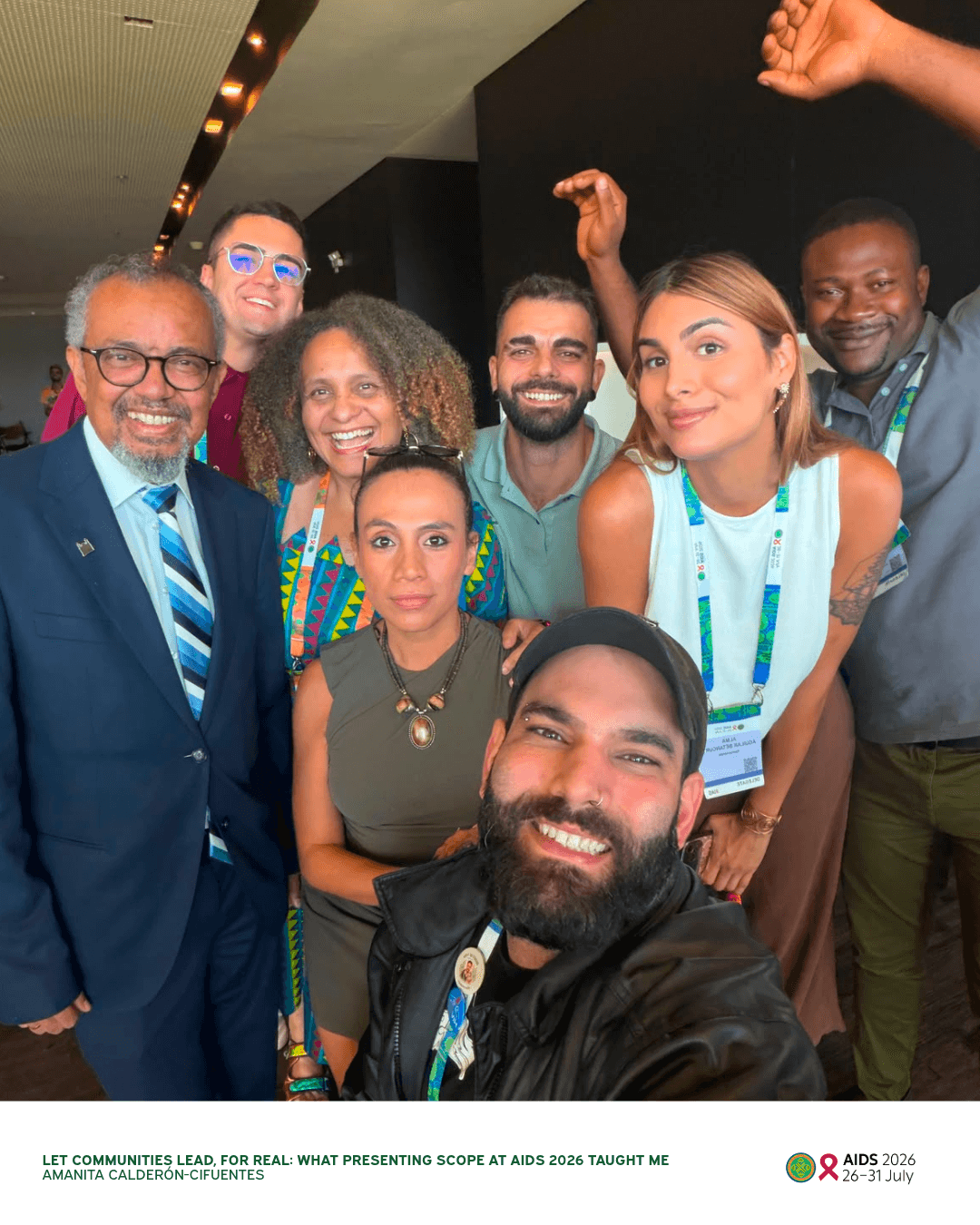
My favourite part of working on EATG’s SCOPE project over the last few years is that it has always felt a little like hanging out with friends who want to change the world just as much as I do.
Since the beginning of the HIV response, communities have created some of its most transformative interventions. In Uganda, people living with HIV and their families founded TASO (The AIDS Support Organisation) in 1987, developing community-led counselling, peer education and home-based care at a time when HIV remained deeply stigmatised. Across the United States and Europe, networks of people who use drugs and HIV activists established and operated needle and syringe programmes, sometimes in defiance of laws and government policy, laying foundations for approaches that would become central to modern harm reduction. These were not interventions designed for communities and subsequently delivered to them: communities themselves identified what was needed and built the response.
When governments ignored a health crisis devastating people they had already pushed to the margins, communities organised. We came together, cared for each other, exchanged information, we fought, we danced, we mourned our dead, and then we did it all over again… day after day…
As Dan Savage said “we buried our friends in the morning, protested in the afternoon, and danced all night.”
Eventually, institutions listened. But institutionalising the HIV response also created distance between programmes and the communities that had built them. Community practices became professionalised, biomedicalised and sometimes removed from the contexts that made them effective. Services may technically exist while remaining inaccessible to someone who expects judgement because they were perceived as “sluts”, “junkies”, “faggots”, “trannies”, or “criminals”.
But what SCOPE did was to challenge that status quo and state clear and loud: communities need to lead, for real.
Taking SCOPE to AIDS 2026
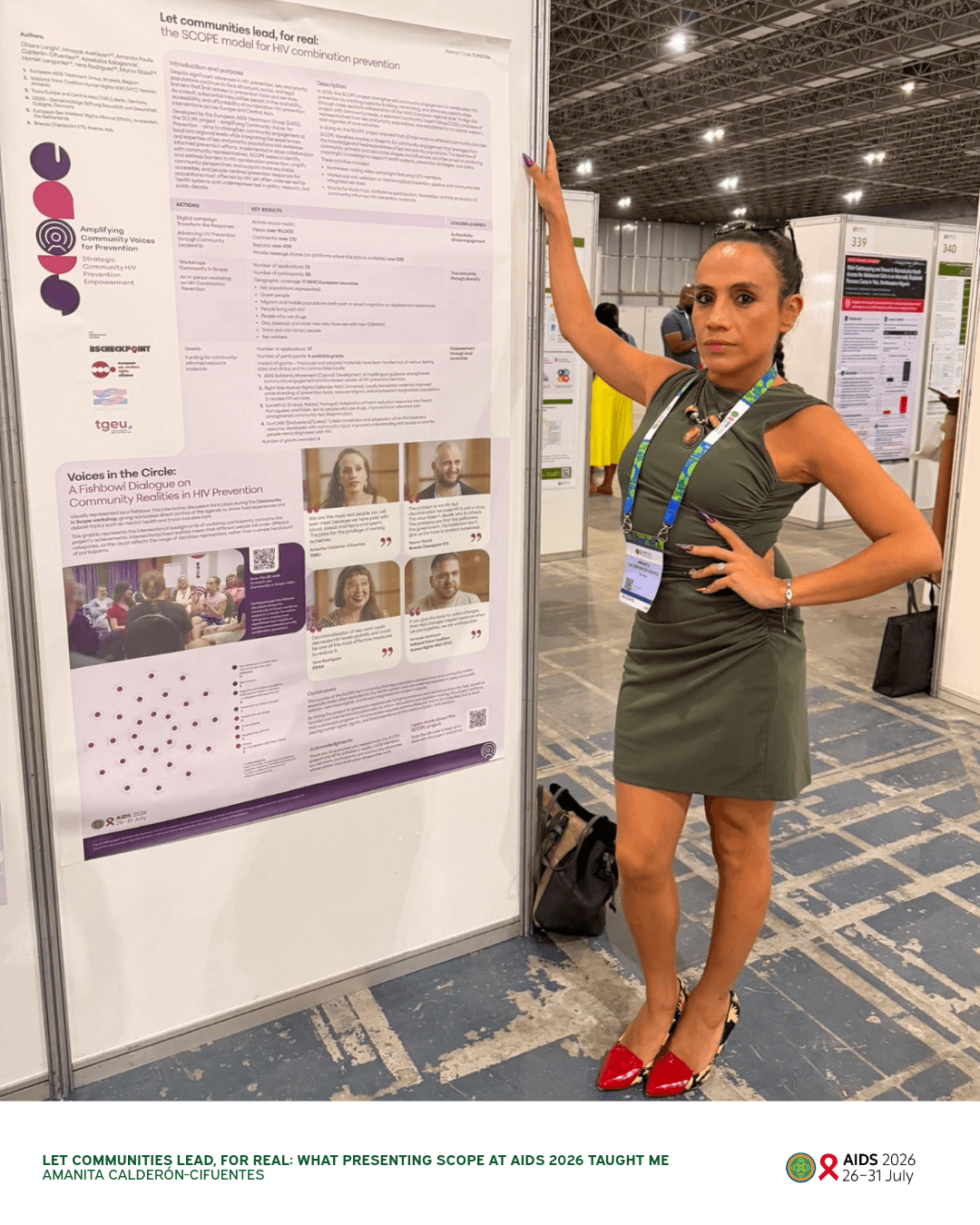
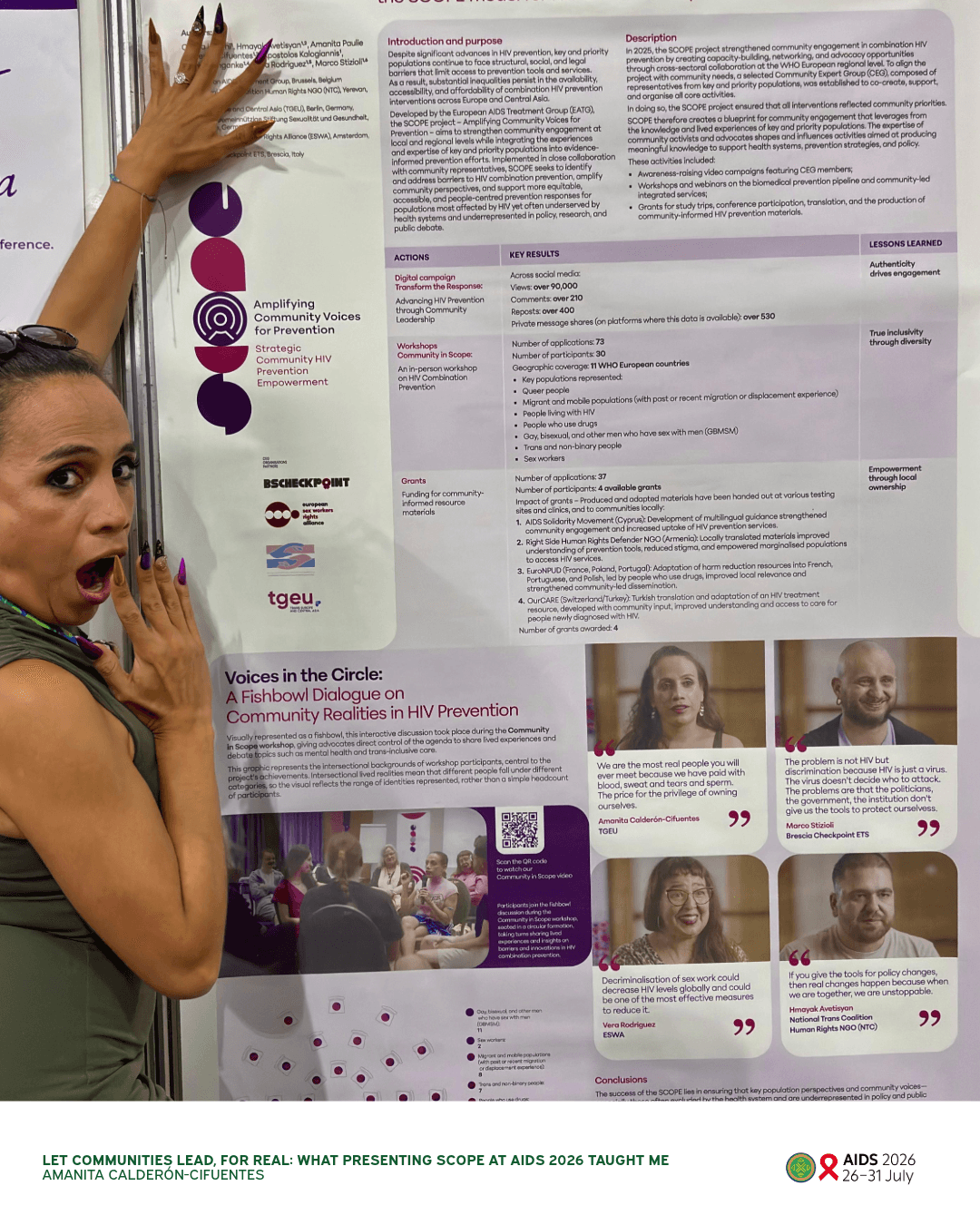
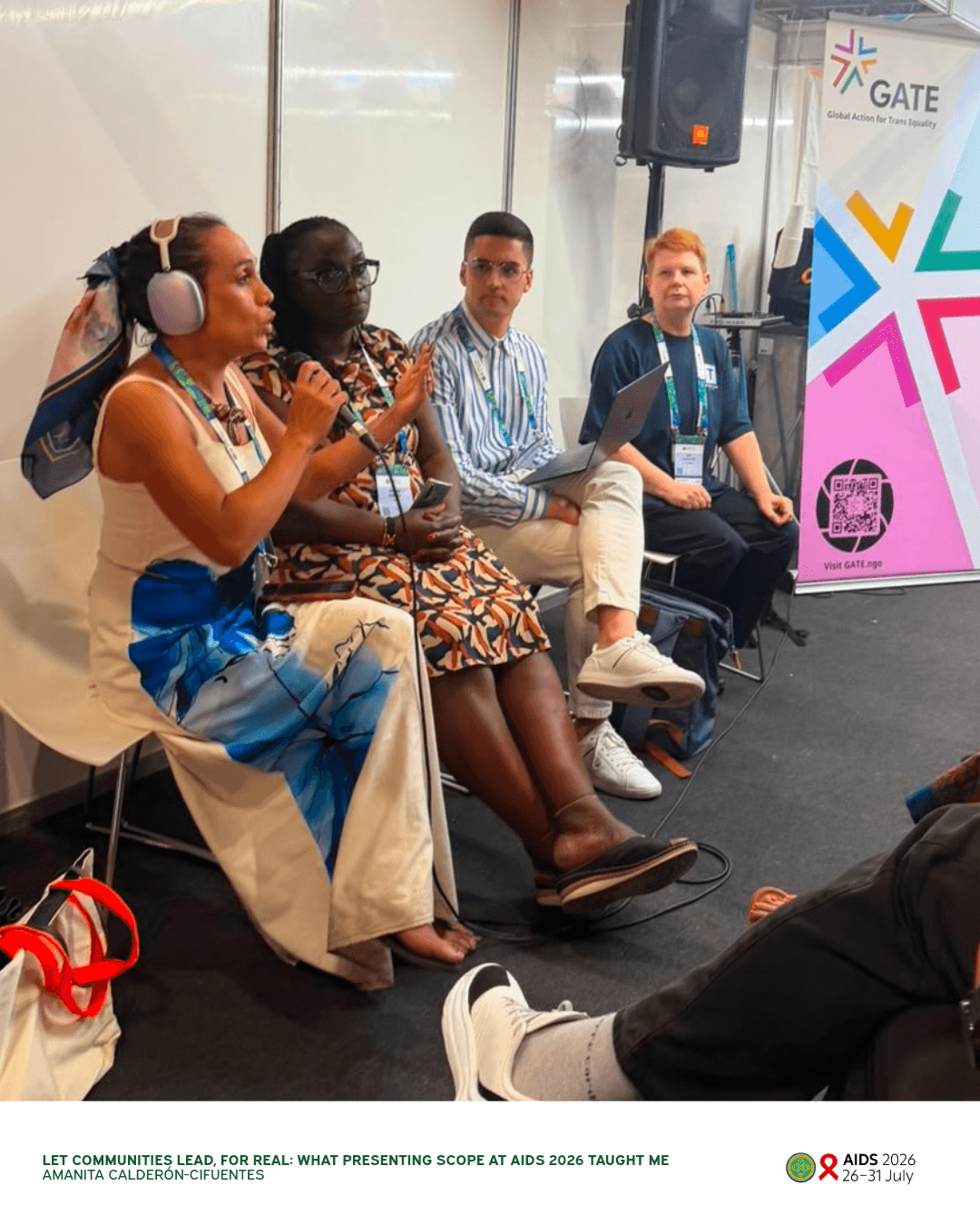
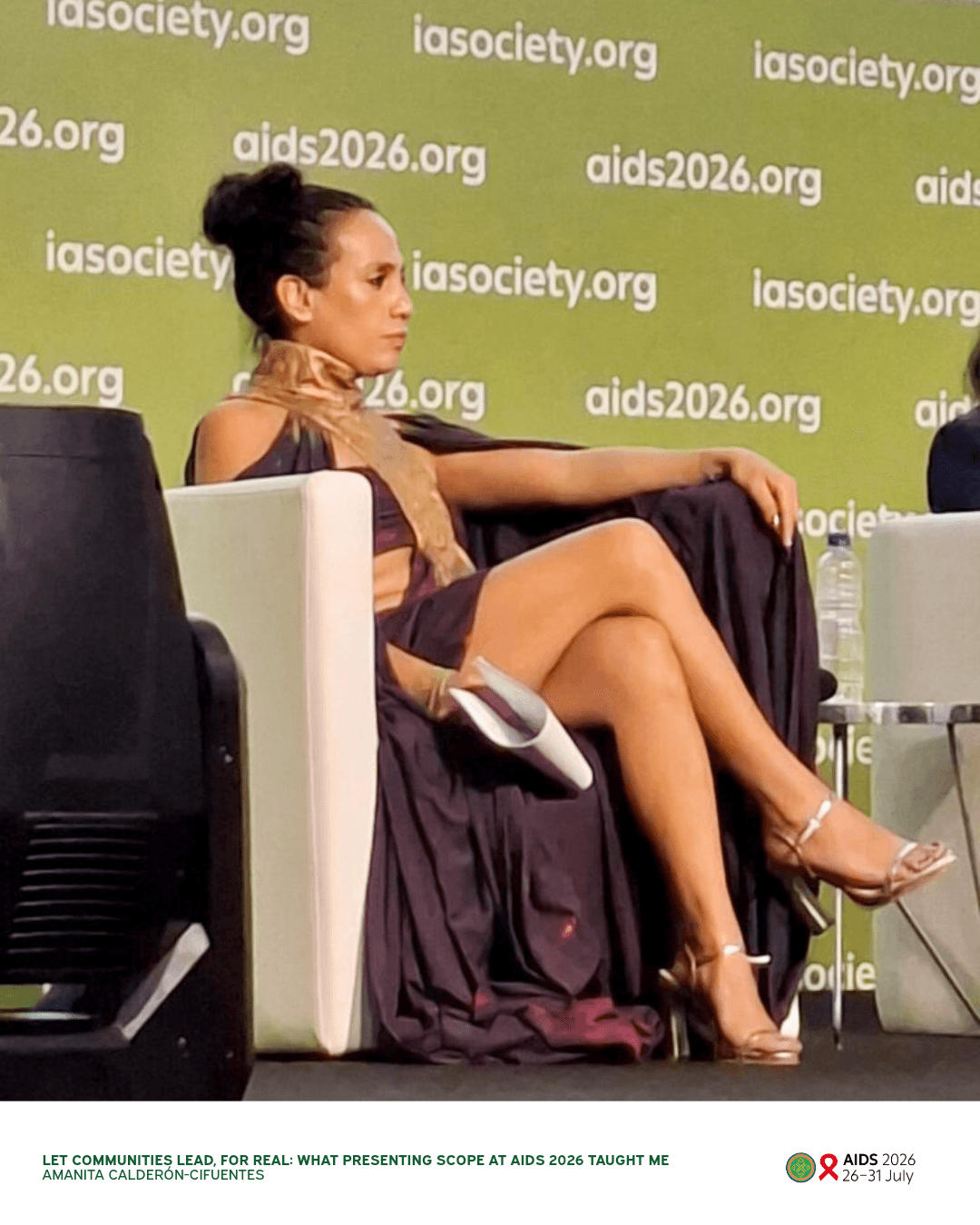
At AIDS 2026, I had the opportunity to present our poster, Let communities lead, for real: the SCOPE model for HIV combination prevention. The poster captured what SCOPE looks like when community leadership becomes a method rather than a slogan.
Three strands of work illustrated this. The Transform the Response digital campaign generated more than 90,000 views. The Community in Scope workshop brought together 30 participants from 11 WHO European countries, representing multiple, intersecting key and priority populations. Community grants supported locally owned, translated and adapted HIV resources. From these experiences came three deceptively straightforward lessons: authenticity drives engagement; true inclusivity requires diversity; and empowerment requires local ownership.
But presenting the poster taught me something else.
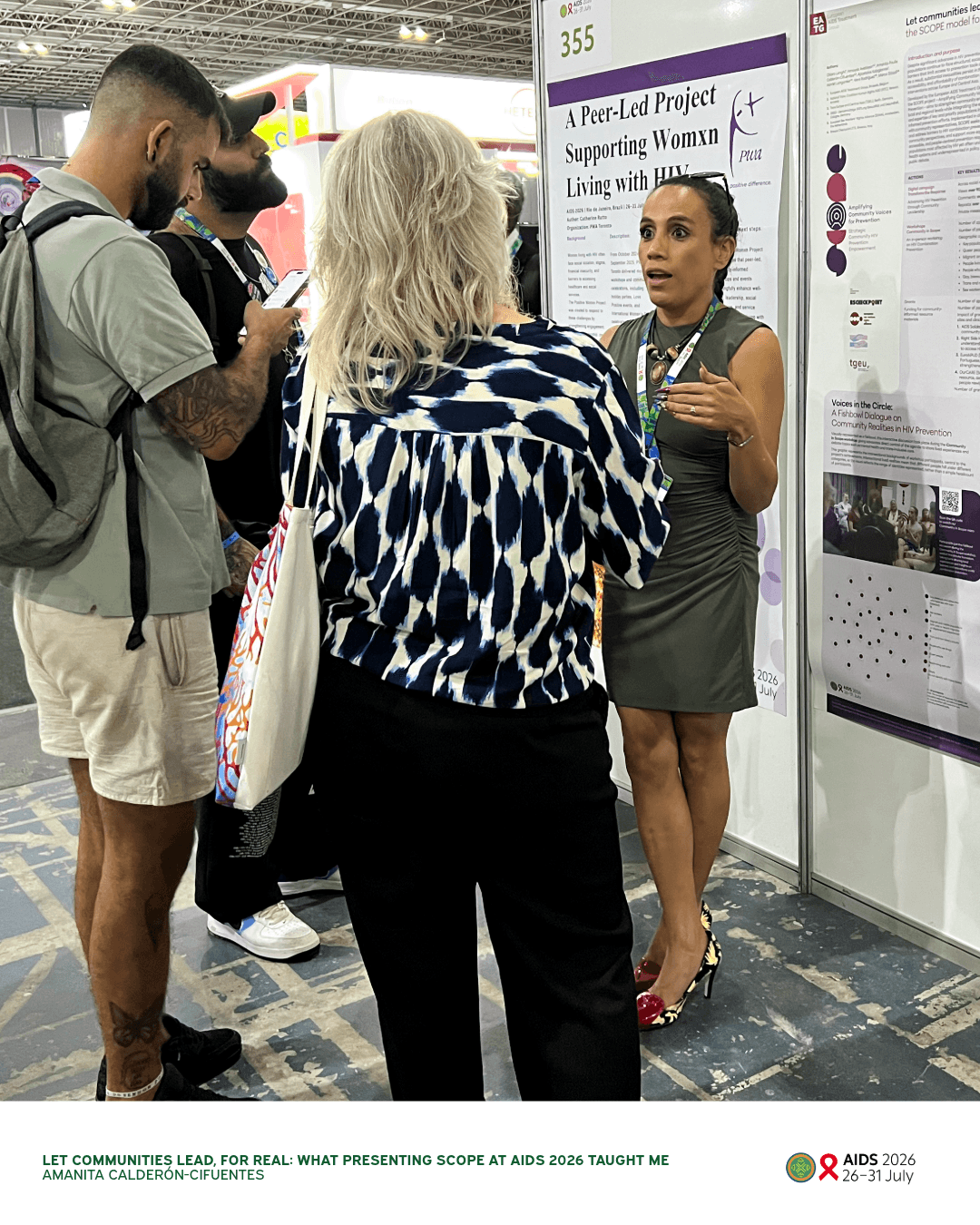
Doctors and researchers stopped to ask questions. They wanted statistics, comparisons, categories and measurable outcomes. I gave them the numbers. But they stayed for the stories.
One conversation particularly stayed with me. A doctor asked which population had higher HIV prevalence: transgender people or sex workers. I asked how long he had worked in HIV. Fifteen years, he said, in New York City.
So I asked: In those fifteen years, how many transgender patients who sell sex have you met?
He paused. He did not know.
That hesitation captured one of the problems SCOPE is trying to address. We routinely organise HIV data into separate population categories, but people do not live in silos. A trans woman may also sell sex, migrate, use drugs and live with HIV. These experiences interact with one another and with racism, poverty, criminalisation, gender inequality and exclusion from healthcare. At our Berlin workshop, participants themselves demonstrated precisely this intersectionality: 30 people generated 43 key-population identifications because many belonged to more than one community.
If we want to understand HIV, we have to stop treating communities as boxes. And if doctors, researches and policy makers want to do a better job, they need to hang the lab-coat and the suits, and go to the closest queer bar, make some friends and realise that we – people living with and highly affected by HIV – are not a monolith, we are the essence of diversity, and WE ARE LEGION.
From prevention to pleasure
Perhaps my favourite example came from Voices in the Circle, a fishbowl dialogue during the Community in Scope workshop in Berlin. Rather than deciding beforehand what communities needed to discuss, the format gave advocates control of the agenda. Conversations moved through mental health, trans-inclusive healthcare and structural barriers to prevention.
And then something beautiful happened: the conversation organically moved from HIV prevention towards pleasure.
What makes you happy? What makes you feel good? What excites you?
These may sound like simple questions, but they expose something fundamental about health. Sexuality, gender expression, drug use and other sources of pleasure are frequently approached through stigma, criminalisation or risk. People whose lives fall outside dominant social norms are then expected to seek services from systems that have already told them that their bodies, desires or behaviours are the problem.
Community-led prevention can begin somewhere entirely different.
It can begin by affirming people’s dignity, bodily autonomy, sexuality, identities and right to pleasure. From there, we can talk about how people want to live and how we can reduce potential harms to ourselves and others. Prevention becomes something we construct with people, rather than something imposed upon them. Because when conversations begin with empathy, curiosity, joy and respect rather than judgement, we create responses people can actually use.
Lived experience is expertise
This was ultimately the message we wanted people encountering our poster at AIDS 2026 to leave with.
Evidence matters. Epidemiology matters. Biomedical innovation matters. But numbers cannot tell us everything about why a prevention technology that works perfectly in a clinical trial never reaches somebody who needs it.
Communities often know why.
We know which doors people are afraid to walk through. We know which language makes someone feel judged. We know why an intervention that looks excellent on paper might fail completely in a particular community. And when we do not know, we know that the first thing to do is ask.
That knowledge is not supplementary to HIV expertise. It is HIV expertise.
SCOPE provides a platform where that expertise can shape research, advocacy, services and policy from the beginning. Its experience reaffirms that sustainable progress in HIV prevention requires communities not merely to be consulted, but to lead—with human rights, dignity and lived experience at the centre.
Presenting SCOPE at AIDS 2026 reminded me why protecting spaces like this matters. Community leadership is not decorative participation. It changes the questions we ask, the evidence we recognise, the interventions we design and, ultimately, who those interventions are capable of reaching.
So thank you, SCOPE. Thank you, EATG. And to everyone deciding what comes next: keep the platform alive.
Because communities have never stopped leading the HIV response.
The rest of the world simply needs to get better at following.
Amanita Calderón-Cifuentes
Community Expert Group Member (SCOPE/EATG)
HIV Research & Advocacy Officer (TGEU)
The SCOPE poster is available under ‘Materials’
Further reading: TGEU at AIDS 2026: Driving conversations on trans health and HIV prevention

Materials
Related Blogs
Get involved
Are you living with HIV/AIDS? Are you part of a community affected by HIV/AIDS and co-infections? Do you work or volunteer in the field? Are you motivated by our cause and interested to support our work?
Subscribe
Stay in the loop and get all the important EATG updates in your inbox with the EATG newsletter. The HIV & co-infections bulletin is your source of handpicked news from the field arriving regularly to your inbox.