
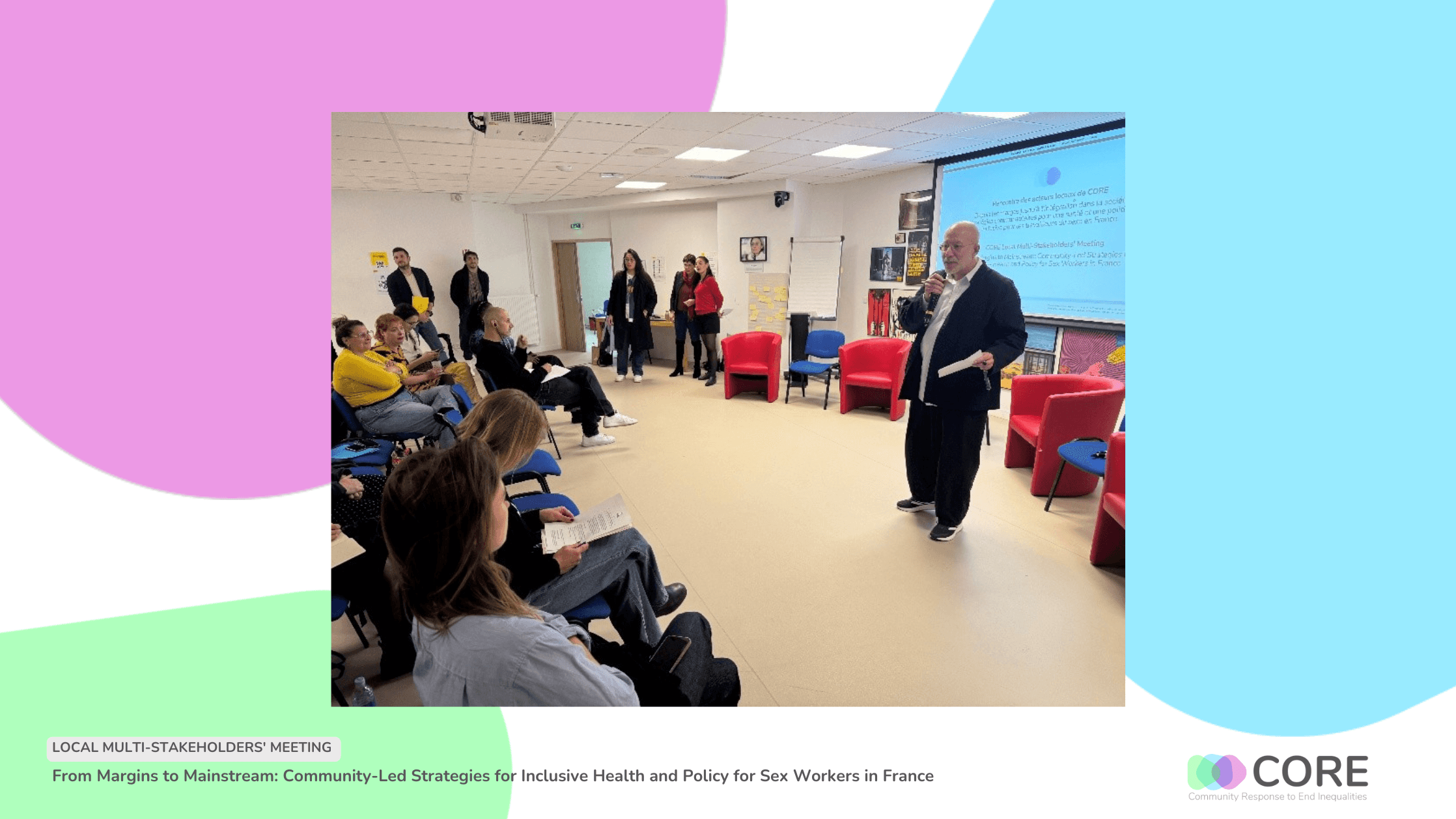
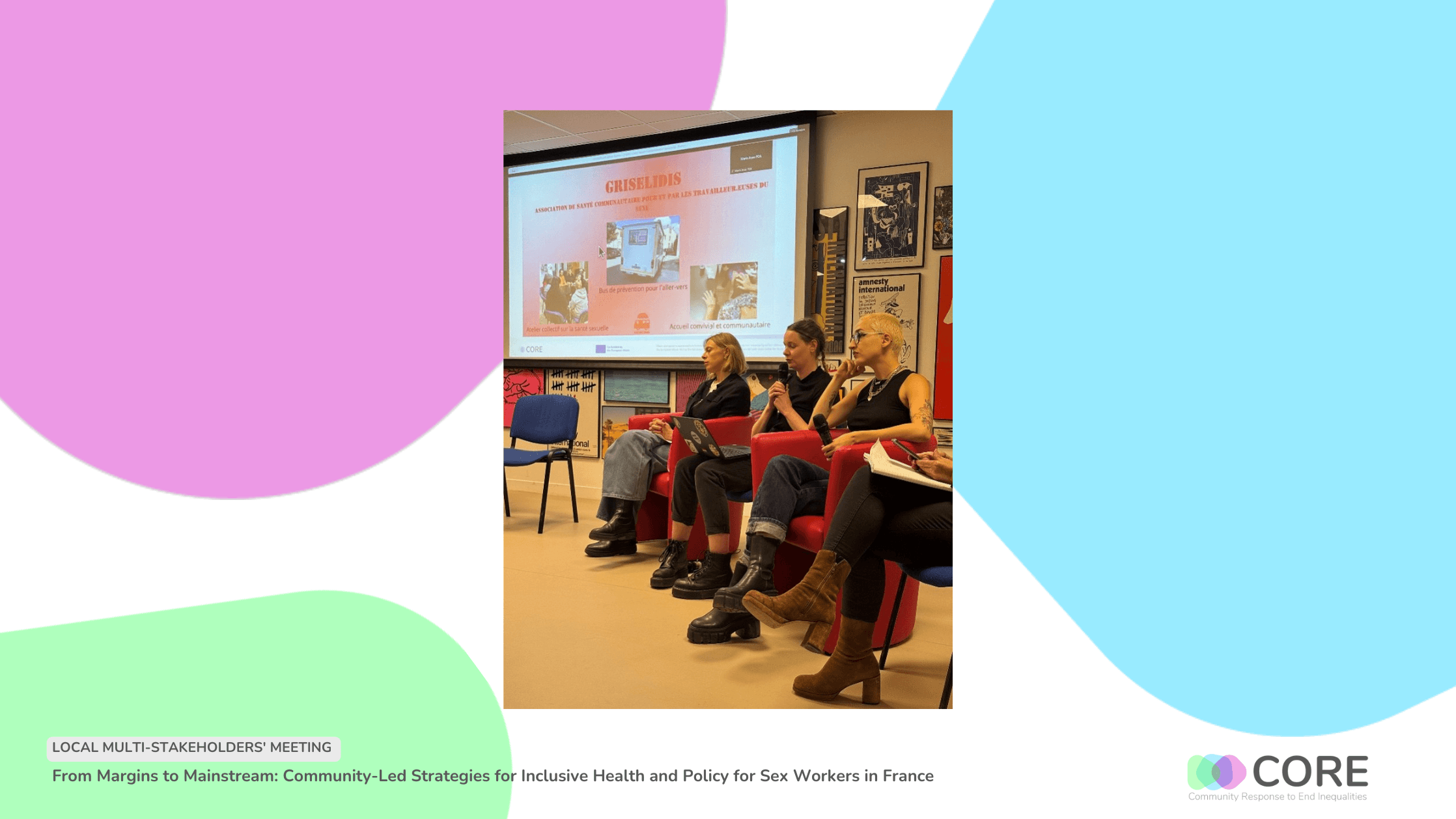
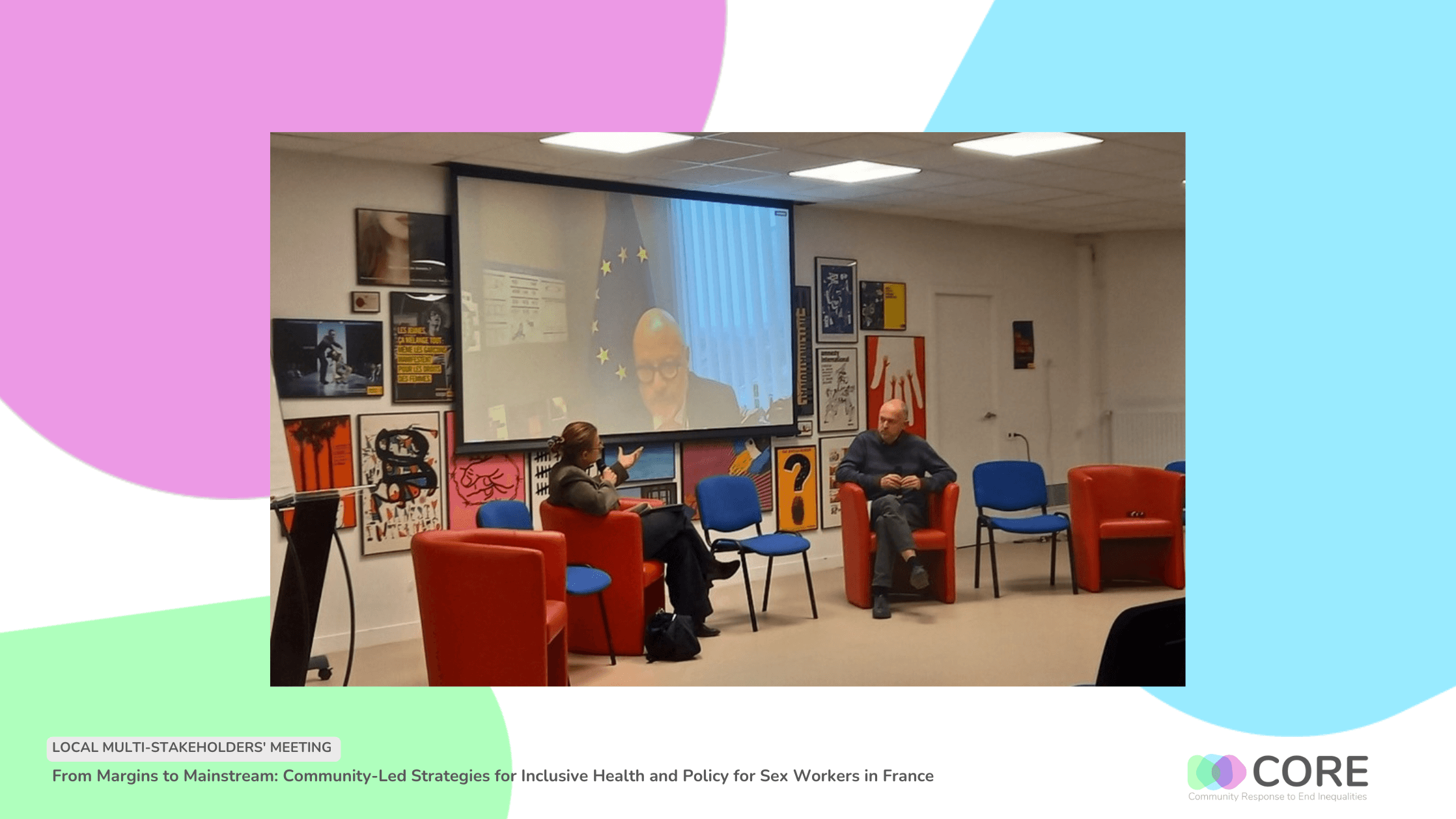
On 14 October 2025, Community Response for Empowerment (CORE) Project organised a multi-stakeholder meeting titled “From Margins to Mainstream: Community-Led Strategies for Inclusive Health and Policy for Sex Workers in France”. The half-day dialogue meeting was convened by Fédération Parapluie Rouge, Médecins du Monde, the European AIDS Treatment Group (EATG), and the European Sex Workers’ Rights Alliance (ESWA). The event provided a rare and timely opportunity, bringing together around 50 participants at Amnesty International’s Paris office, bridging policy makers, city authorities, sex workers, institutions, and European partners in the lead-up to the 2025 European AIDS Clinical Society (EACS) Conference in Paris.
A key highlight of the event was a strong political presence and public commitments from Parisian and European policymakers.
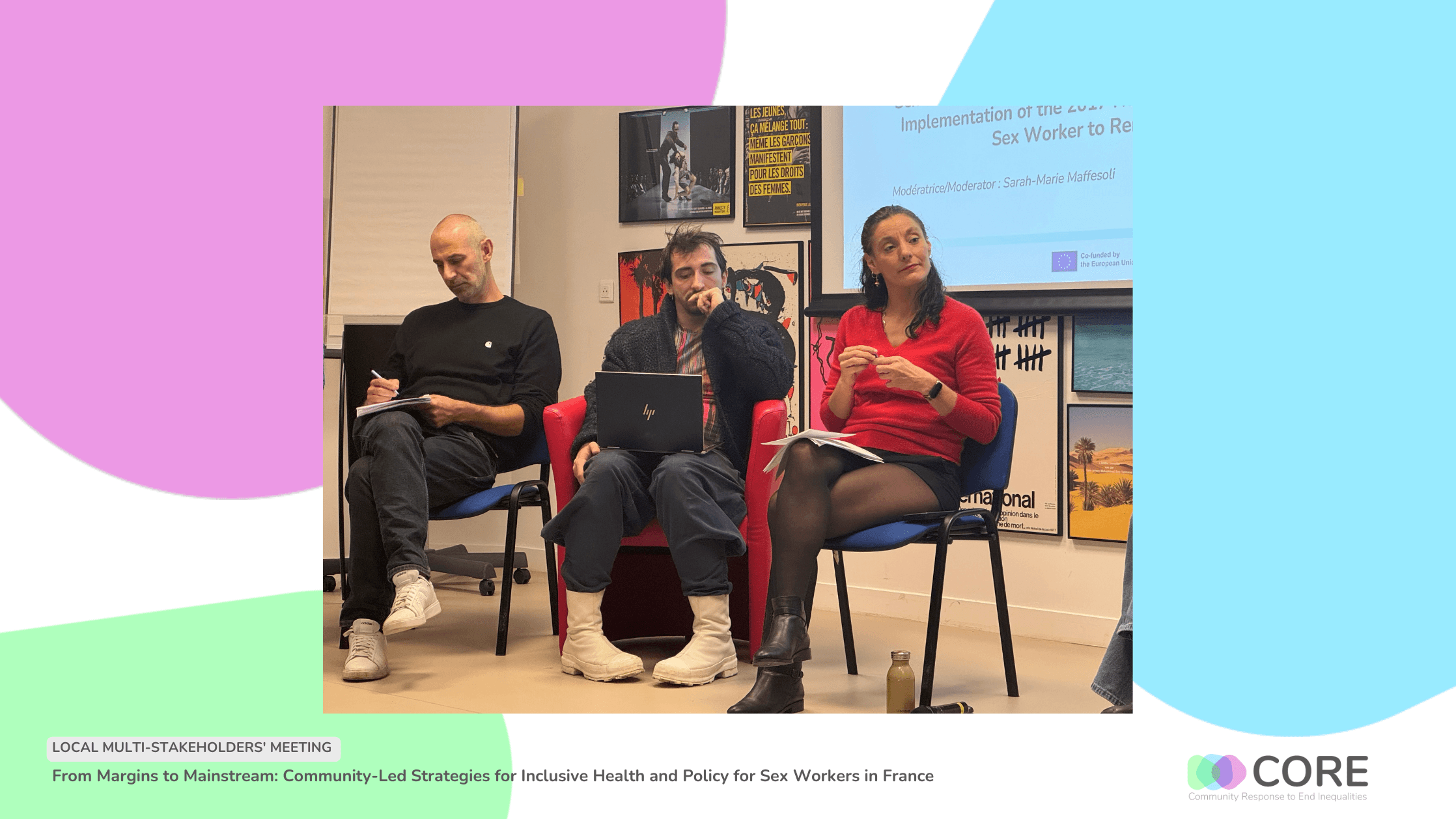
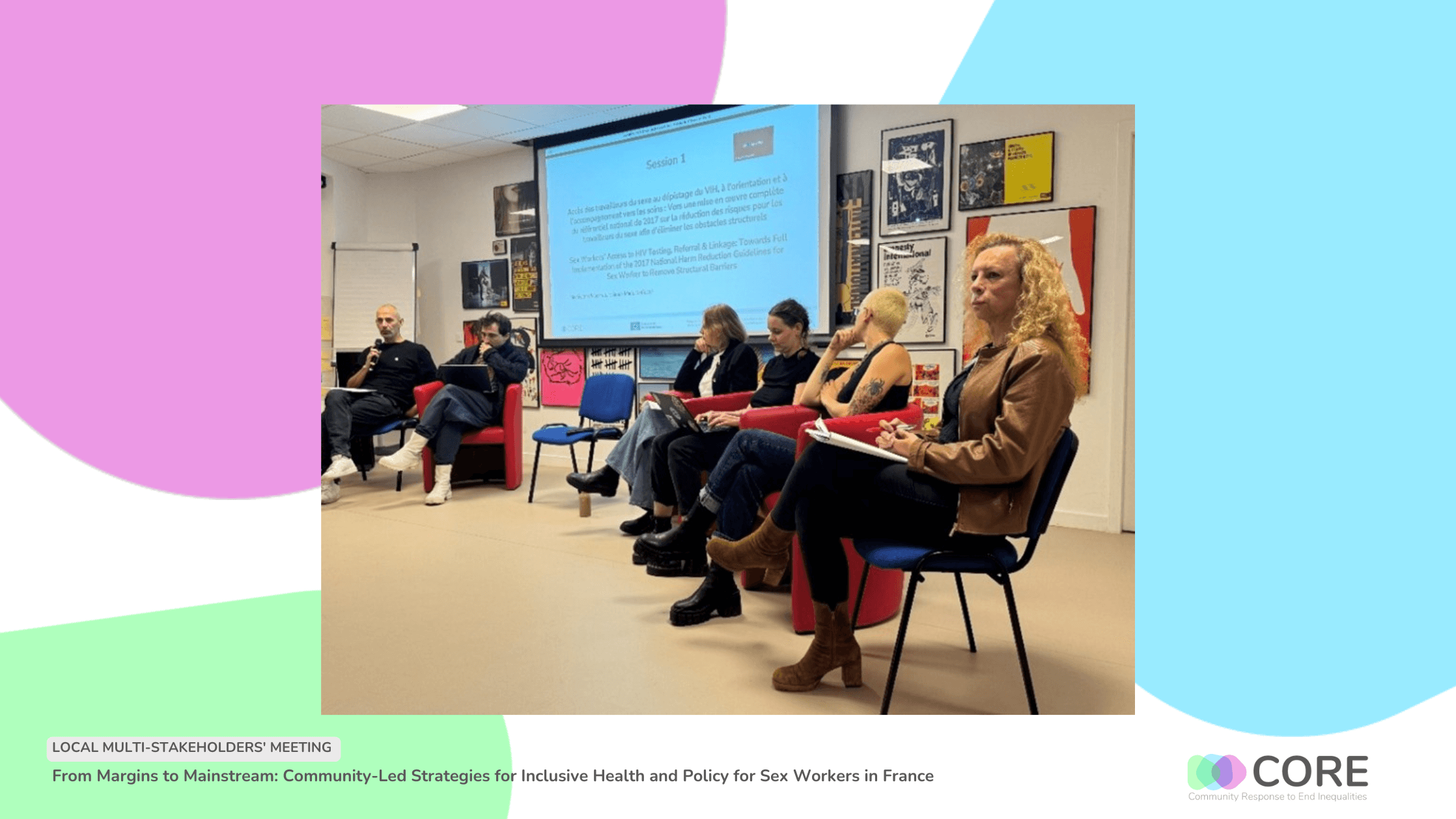
Deputy Mayor of Paris Anne-Claire Boux attended the half-day event. She emphasised the city’s responsibility to uphold inclusive public health policies and protect communities most affected by HIV. Member of the European Parliament Marc Angel underscored the importance of rights-based approaches across EU member states, noting his work with the LGBTQI+ Intergroup. Senator Anne Souyris reflected on decades of advocacy for sex workers’ rights and the need for evidence-based reforms within health system to serve sex workers. Koen Block, from the International Planned Parenthood Federation, moderated the discussion. He highlighted the regional significance of France implementing its comprehensive 2017 national harm-reduction guidelines fully, which were developed with a wide consultative process.
Together, leaders reinforced the necessity of aligning local and European political will with the leadership and expertise of community-based and led organisations to improve access to HIV testing, prevention and treatment on the ground.
Sex workers delivered powerful contributions that grounded the discussions in lived experience and practical innovation.
Anatole Dash spoke about the transformative value of peer-led outreach; Sarah-Marie Maffesoli of Médecins du Monde highlighted legal and social barriers that continue to undermine harm reduction; and Camille Desalle of Grisélidis described shifting needs identified by sex workers through their community-centred services. Cabiria’s Antoine Baudry and Maribel Cabrera shared insights from their prevention and cultural mediation work, especially with migrant and Spanish-speaking sex workers, while Marie from Partage Droits et Autonomie drew attention to the isolation faced by sex workers in rural regions. Activist and Acceptess T director Giovanna Rincon captured the urgency of structural reform, linking community struggles to broader trans and feminist movements.
Collectively, these speakers demonstrated potential and expertise within sex workers organisations for health promotion, rights advocacy, and narrative change for communiities by communities.
The event produced several concrete outcomes.
The Health General Direction invited organisers to present the showcased projects for further consideration by authorities; elected officials expressed significant interest in supporting dialogue with the communities moving forward; and the meeting strengthened recognition of community-led innovation among institutional and financial partners. The entire programme, filmed in three advocacy-oriented videos, will continue to amplify community voices at national and European levels. As Paris prepared to host the EACS Conference, the gathering positioned sex workers’ rights, leadership, and expertise at the centre of public health and human rights discussions.
About the CORE project
The CORE Project (“Community Response to End Inequalities”) aims to reduce inequalities by promoting, strengthening and integrating the community responses that have proven key in bringing services closer to persons who would benefit most but face inadequate access, in particular countries where these responses are still lacking. This will happen through capacity building, networking, and the exchange of good practice and innovative approaches, as well as through a proactive outreach and engagement of relevant stakeholders, while addressing legal, policy, and structural issues to promote integration of these approaches into disease prevention and health promotion strategies and systems.
The CORE project will build on and intensify collaboration of regional networks and national and local organisations of people living with HIV, key populations, and service provider organisations. It will use, adapt, and disseminate existing national, regional, and global good practice approaches and tools from across key populations and disease areas, and provide platforms for exchange.
Read more about the CORE consortium and its plan of action here: https://core-action.eu/core-home.
#COmmunityREsponse
#COREActionEU
#EU4Health
#HealthUnion

The CORE project has received funding from the Health Programme of the European Union under grant agreement No 101080079.
Related News
Get involved
Are you living with HIV/AIDS? Are you part of a community affected by HIV/AIDS and co-infections? Do you work or volunteer in the field? Are you motivated by our cause and interested to support our work?
Subscribe
Stay in the loop and get all the important EATG updates in your inbox with the EATG newsletter. The HIV & co-infections bulletin is your source of handpicked news from the field arriving regularly to your inbox.