
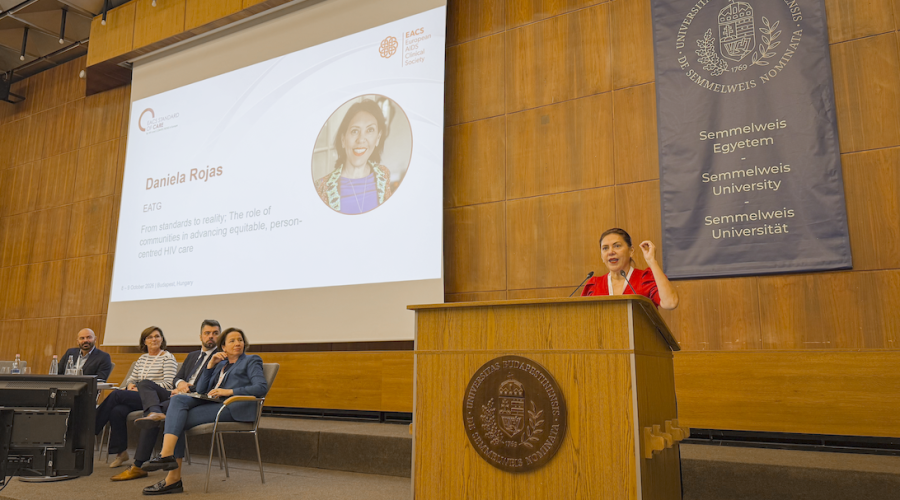
Our Chair, Daniela Rojas Castro, represented EATG at the 7th EACS Standard of Care Meeting in Budapest on 8–9 October 2026. In her blog, she highlights the role of communities in advancing equitable, person-centred HIV care and calls for meaningful community engagement in developing, implementing and monitoring European standards.
On 8–9 October, I represented EATG, as Chair of the Board of Directors, at the 7th EACS Standard of Care Meeting for HIV & Co-infections in Europe. It was hosted by Semmelweis University in Budapest and co-organised with Hungary and Albania. More than 120 participants from 17 countries spent two days on one question: how do European standards of HIV care become the care people actually receive?
On 9 October I spoke on behalf of EATG in the policy session “Advancing Standards of HIV Care and Prevention: Policy Impact, Political Commitment and European Leadership”. My presentation focused on the role of communities in equitable, person-centred HIV care.
What EATG brought to the room
The ECDC/EACS Standards are minimum standards. They are auditable, co-developed, and person-centred by principle. EATG nominated the community representatives to their Advisory Group, and EATG members sat in the writing group of the co-morbidities module. The mental health and lifestyle chapters carry community input.
Axel Vanderperre and Filippo von Schloesser, EATG members of the co-morbidities writing group, reviewed my slides ahead of the meeting and helped ensure they accurately reflected the work and contributions to the group. I thank them for that.
But there is still a gap between what standards promise and what people meet.
- In the EACS–ECDC survey of healthcare staff (2023, 18,430 respondents, 54 countries), 69% lacked knowledge of key concepts on HIV transmission and prevention. 26% said they would wear double gloves. 30% had witnessed discriminatory remarks.
- In the published modules, the testing quality statement on stigma and criminalisation has no indicator.
- Menopause, long-acting ART for treatment, loneliness, out-of-pocket costs and income are not mentioned at all.
Participation is real, but still thin: one community member out of ten in the ART writing group, two out of twelve in co-morbidities.
Communities bring three things. We co-create. We translate standards into practice: CHECKUP+ project, built by a member of the co-morbidities writing group, helps people with HIV prepare their consultation along the module’s chapters. And we monitor and hold to account.
What we asked as EATG
- Measure what people experience. Develop experience-based indicators, starting with stigma.
- Fund engagement structurally. Budget the role of civil society in audits and data, as already raised in Athens in 2024, not as an add-on at the end.
- Co-own the next modules. Have diverse, resourced community co-leads, starting with the upcoming module on engagement in care, then stigma and person-centred care.
I also told the room that EATG, a pan-European network of people living with HIV across 37 countries, is ready to partner on experience-based indicators and community-supported audits.
EACS closed the meeting with a message close to ours: standards matter, but their impact depends on implementation, political commitment and meaningful community engagement.
It was great to see there some many of you: Gus, Bogdan, Olimbi, Chris, Robert, Magda…
Standards are written for people. They become reality when people help shape them, deliver them and check them!
Daniela Rojas Castro
Chair of the Board of Directors, European AIDS Treatment Group

Related Blogs
-
America First, One Year On: The IAS’s Responsibility
-
16 Days of Activism Against Gender-Based Violence | Confronting Violence to Claim Our Freedom and Strengthen the HIV Response
-
16 Days of Activism Against Gender-Based Violence | Interpersonal Violence Among Women and Transgender Women Living With HIV: The Role of Systemic Violence and Racism
Get involved
Are you living with HIV/AIDS? Are you part of a community affected by HIV/AIDS and co-infections? Do you work or volunteer in the field? Are you motivated by our cause and interested to support our work?
Subscribe
Stay in the loop and get all the important EATG updates in your inbox with the EATG newsletter. The HIV & co-infections bulletin is your source of handpicked news from the field arriving regularly to your inbox.